independent advisory for relocation and long-term engagement in AFrica

COUNTRY INTELLIGENCE
KENYA
Kenya 2026:The Silicon Savannah Ascendant
From Digital Nomadism to Global Institutional Hub
The Africa File · March 2026
For informational purposes only. Does not constitute legal or financial advice.
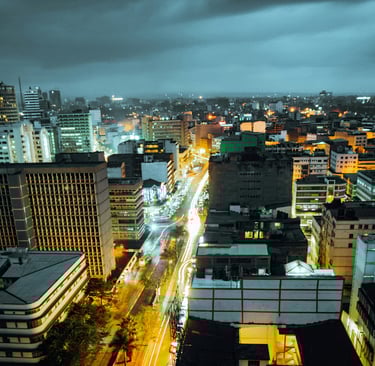
In 2019, Kenya was Africa's mobile money leader. By March 2026, it had become something larger: the Continent's administrative and technology capital, on the way to a $265 million United Nations infrastructure upgrade and running the most clearly structured digital nomad permit in East Africa. The Central Bank Rate is at 8.75 percent. Inflation is at 4.3 percent. The shilling is holding in the 125 to 132 range against the dollar. For Americans earning in dollars, the purchasing power case for Nairobi is not a pitch. It is arithmetic.
This piece covers five key aspects shaping Kenya in 2026, with data precise enough to act on. The full Kenya brief carries everything else: verified monthly budgets for four named profiles, the Ardhisasa title verification protocol, the Class N permit checklist, and the tax architecture that makes the numbers work.
1. THE INSTITUTIONAL SURGE: WHAT THE UN RELOCATION MEANS FOR HOUSING
The United Nations is in the final stages of relocating UNICEF, UNFPA, and UN Women operations to Nairobi. Thousands of international staff are arriving in Gigiri, Rosslyn, and Westlands. The direct effect on housing is measurable: a 10 to 15 percent increase in rental prices in executive-tier properties across those three areas, with the staffing peak expected in Q3 2026. Stock in gated, generator-backed apartments in that corridor is thinning faster than it is being built.
Move before that peak. Standard lease structure has not changed: one month security deposit and two months advance rent. What is under pressure is availability. Identify your shortlist during a 30 to 60-day pilot trip and be ready to sign when the title verification clears.
The Carters, Karen, $6,550 per month. Karen is where families discover that a high combined income operates very differently than it does in Houston. Four-bedroom gated compound, garden and staff quarters, two children in an international school, full household help, and a car. Annual savings that simply were not possible at home. The full brief has the complete budget breakdown and the neighborhood profile.
2.THE CLASS N PERMIT: KENYA'S MOST CONSEQUENTIAL IMMIGRATION PRODUCT
Kenya's Class N Digital Nomad Permit is the clearest legal entry point for remote professionals in East Africa. There are two income thresholds that matter here, and the gap between them is where most newcomers find their first friction. The permit comes with a specific prohibition that triggers a different legal pathway the moment local Kenyan revenue becomes material, and that conversation needs to happen with the right lawyer before the first local invoice goes out, not after.
Jasmine, Westlands, $78,000 per year. Properly structured, her effective US tax rate is around 1.5 percent. Her annual savings, after Nairobi rent and living costs, are $29,100. The brief carries the full Class N document checklist, the eFNS portal walkthrough, and the Class M transition timeline for year two.
3. ARDHISASA: WHAT DIGITAL LAND REFORM ACTUALLY MEANS FOR YOU
Kenya's Ministry of Lands completed its migration to fully digital land records on March 1, 2025. The Ardhisasa platform is now the sole verified source for title records. It includes a seller consent mechanism that makes the ghost title fraud, once prevalent, structurally harder to execute. Paper mutation forms are now obsolete. Any agent presenting a stamped paper search as a standalone verification in 2026 is handing you an incomplete document. The verification process will not take longer than 30 minutes when you know what you are doing.
Marcus, Kilimani, $140,000 per year. He ran title searches on three shortlisted properties during his pilot trip and found problems with two of them before any money changed hands. The delay cost him some additional accommodation, but it protected him from expenses that would be considerably larger. His Kilimani one-bedroom has a verified clean title and a confirmed building borehole.
4. INFRASTRUCTURE 2026: THE SELF-MANAGED, HIGH-CEILING ENVIRONMENT
Nairobi's infrastructure ceiling is genuinely high. Fiber is standard in most modern apartments and 5G coverage is near-complete across the main upscale neighborhoods, but the floor requires active management. Kenya Power reported in February 2026 that rooftop solar expansion is creating localized grid disturbances, and that is a standard operating condition rather than an exceptional one.
The setup investment for a remote professional who cannot afford downtime is specific and manageable. Thus, he must know the exact specification, the costs, and questions to ask before signing any lease, including the borehole licensing question that caught several newcomers off guard.
Robert, Lavington, $3,200 per month. His two-bedroom at KES 120,000 per month comes with a generator, building borehole, and a valid WRA permit, which the property manager produced before he signed. He confirmed the generator covers his full apartment, not just common areas. In Nairobi, that distinction matters
5. MACROECONOMIC UPDATE: MARCH 2026
The Central Bank Rate cut to 8.75 percent in February 2026 reflects a stabilizing economy. For American remote workers, the more relevant number is $126,500. This is the current Foreign Earned Income Exclusion threshold. When structured correctly, most remote workers in Kenya are operating at a 2 to 4 percent combined effective tax rate. The mechanism that protects offshore income from Kenyan taxation is specific. For instance, it is critical to know that the 183-day threshold is actively monitored rather than self-reported, and both require proper setup from day one rather than reconstruction later.
Marcus, $140,000 per year, 2.5 percent effective tax rate, $54,300 saved. The FEIE excludes $126,500. He transfers about $2,200 per month to Kenya. In Atlanta, on the same income, he saved $30,000 to $40,000 per year. Over three years, the differential exceeds $200,000.
Robert, $50,000 passive income, lifestyle advantage. Passive income does not qualify for the FEIE. The non-remittance principle protects what he keeps offshore. His advantage is the upscale lifestyle: A beautiful home around $3,000 per month, full-time household help, a car and driver, and a private club membership. His pension does not buy that in Houston.
THE FULL KENYA BRIEF
Making Kenya home requires a few steps; for instance, working on key critical documents, such as The Class N, which provides the legal runway, Ardhisasa, which removes the property fraud risk that once defined the newcomer experience, and more. The advantages are real and measurable, but preparation and planning are still necessary.
The Africa File Kenya 2026 brief carries the complete Class N document checklist and eFNS walkthrough, the three-phase Ardhisasa zero-loss protocol, verified monthly budgets for Marcus in Kilimani ($2,178 per month, $54,300 saved), the Carters in Karen ($6,550 per month, $42,300 saved), Jasmine in Westlands ($2,171 per month, $29,100 saved), and Robert in Lavington ($3,200 per month), plus the full FEIE and non-remittance tax architecture and neighborhood profiles across Kilimani, Westlands, Karen, Lavington, and Gigiri.
Nairobi is on the rise. The question is not whether the opportunity is real. The question is whether your legal, financial, and physical setup is ready for Kenya.





Questions? Reach out anytime for guidance.
Call
info@bethindthemaps.com
+1-929-216-9963
© 2025. All rights reserved.